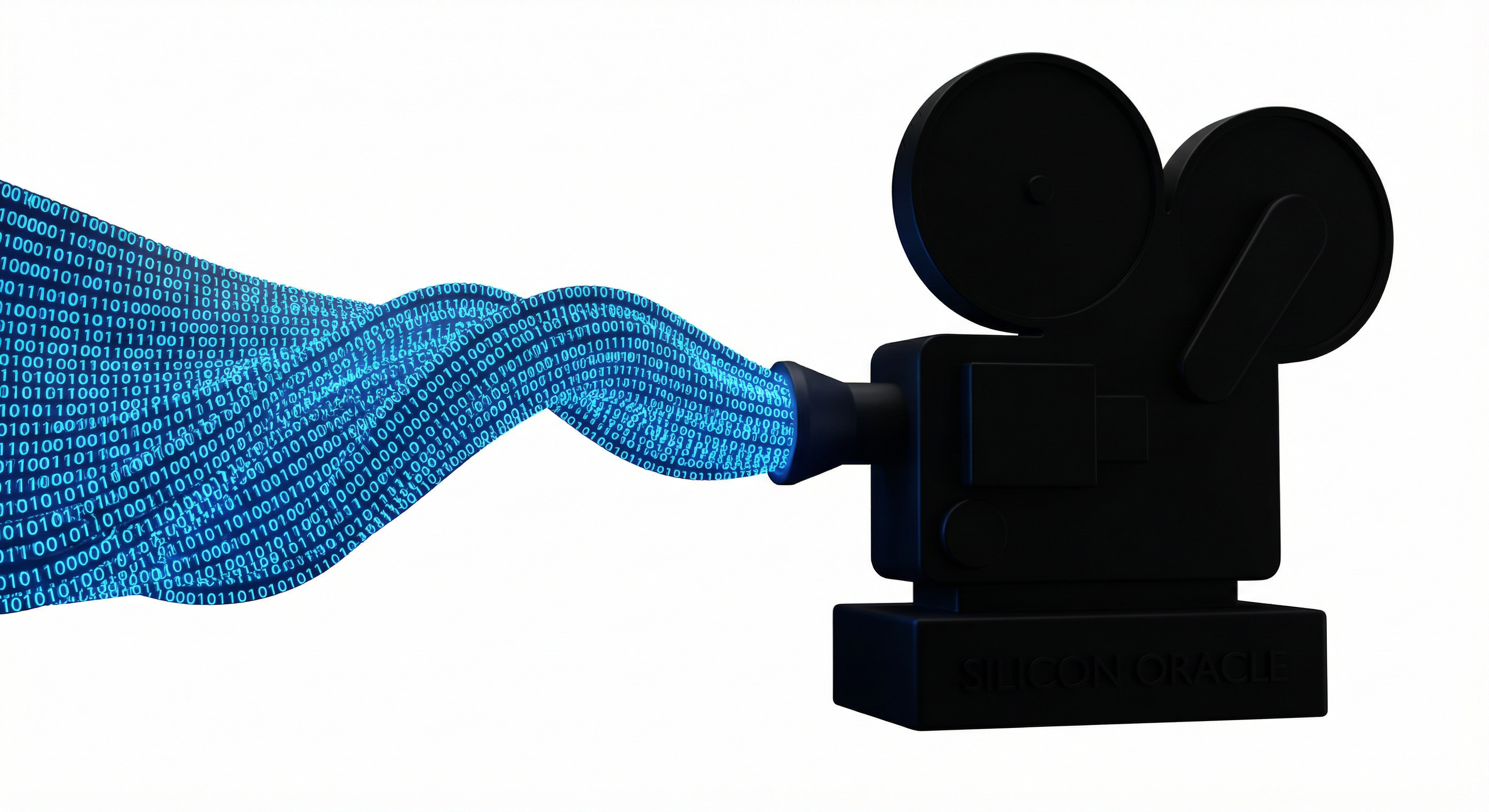
The Two-Line Apocalypse: Seedance 2.0 and the End of the Cinematic Monopoly
- The Hook: The 15-Second Harbinger
In February 2026, the perceived value of human craftsmanship underwent a violent devaluation in the span of a single afternoon. It was not a policy shift or a market crash, but a 15-second video file that served as the harbinger of a new, post-labor creative order. The clip, shared by director Ruairí Robinson, featured Tom Cruise and Brad Pitt engaged in a visceral, hyper-realistic brawl atop a rooftop in a post-apocalyptic wasteland. Every bead of sweat and every splinter of wood felt authored, yet Robinson’s revelation was the true "singularity moment": the entire spectacle was triggered by a mere "two-line prompt" in ByteDance’s Seedance 2.0. The shot costs forty-two cents; the career cost forty years.
For the viewer, the experience is pocket-sized—a flickering marvel on a smartphone screen. But this triviality belies the staggering gap between the user’s casual intent and the machine’s execution. While the prompt is a few characters of text, the output requires the coordinated fire of a distant, cloud-bound sovereign—a data center humming with the processing power required to simulate reality itself. The infrastructure of cinematic truth has been centralized, moving the keys to the kingdom from the Hollywood backlot to the server farm.
The Silicon Titan vs. The Struggling Generator
Seedance 2.0 is the evolution of ByteDance’s "Seaweed" project—a 7-billion-parameter beast forged from the compute equivalent of 1,000 NVIDIA H100 GPUs. This architecture represents a collision of worldviews: the "Cloud Power" of unlimited compute versus the traditional "Local Agency" of the human creator. We have returned to the centralized power plants of the 19th century. Just as early factories were tethered to a massive, singular steam engine, the modern filmmaker is now increasingly dependent on a "Silicon Titan" housed in a distant data center. The local, human-driven production house—with its physical sets and finite labor—has become the struggling household generator, unable to compete with the sheer output of the cloud’s simulated physics.
The Architecture of a World Model
The strategic importance of Seedance 2.0 lies in its departure from "stitching pixels" toward "calculating physics." In practical testing on the SeedVideoBench-2.0, the model has already begun to outperform competitors in motion stability and physical consistency. It does not dream movement; it calculates trajectories. At the heart of this shift is the Dual-Branch Diffusion Transformer (MMDiT). This architecture functions like a digital brain, utilizing an Attention Bridge—a silicon "corpus callosum"—to coordinate the visual branch (spatial rendering) with the audio branch (acoustic functions).
This coordination eliminates the "uncanny valley" of desynchronized media. When a Wuxia-style swordsman strikes in the rain, the model generates the "ring-shaped shockwaves of rainwater blasted away by the blades" while simultaneously calculating the millisecond-accurate crack of steel.
To solve the "character morphing" problem, Seedance 2.0 introduces a 12-File Reference Capacity, or "Directorial Stack":
- The Subject Anchors: Users can upload up to 9 images to lock in character faces, clothing textures, and environment styles.
- The Motion Templates: Up to 3 videos can be used to dictate specific camera trajectories—like a dolly zoom—or complex choreography.
- The Acoustic Lead: Up to 3 audio files drive the visual pacing, ensuring the "physics" of the scene match the rhythm of the sound.
This precision is not free. Latency is the tax paid for tapping into this cloud-based supremacy. Simulating a world in 2K resolution across a unified multimodal architecture requires a delay that a local GPU simply cannot avoid. You are no longer rendering; you are waiting for a distant reality to be synthesized and shipped back to you.
The Hollywood "Smash-and-Grab"
The brilliance of the architecture is currently overshadowed by a legal minefield. Hollywood’s major players—Disney, Warner Bros. Discovery (WBD), and Paramount—have launched a unified offensive against what they call a "virtual smash-and-grab." The conflict highlights a strategic divergence: while OpenAI secured a $1 billion deal with Disney to license characters, ByteDance allegedly took a "pre-loaded" approach, treating the history of cinema as free public domain clip art.
The tension is deeply personal. WBD’s cease-and-desist letter was addressed directly to ByteDance’s General Counsel, John Rogovin, who previously spent his career at Warner Bros. protecting the very characters—like Batman and Superman—that Seedance 2.0 now replicates with ease. WBD legal chief Wayne Smith has been aggressive, demanding that ByteDance not only stop the training but identify all training materials used, a move intended to crack open the black box.
The Industrialization of the $3,000 Shot
For the creative economy, the shift from a 20% success rate to 90% is the true apocalypse. Generative AI has moved from "creative play" to "industrial manufacturing." The traditional cost of a high-end, 5-second VFX shot—requiring a senior artist’s month of labor—hovers around $3,000. Seedance 2.0 delivers that same shot for as little as $0.42.
| Metric | Traditional VFX Studio | Seedance 2.0 Model | | :--- | :--- | :--- | | Cost per Shot | ~$3,000 | ~$0.42 | | Efficiency Gain | Baseline | ~1,000x | | Success Rate | ~20% (requires iteration) | ~90% (one-shot prompt) | | Process | Manual Labor & Rendering | Industrial Calculation |
The machine does not dream; it calculates. It takes the sweat of a thousand stuntmen and reduces it to a floating-point variable. As Deadpool screenwriter Rhett Reese noted, "it's likely over for us." This shift represents the erosion of "digital veracity." When one person can generate a high-fidelity cinematic sequence in minutes, the value of the human "vision" begins to evaporate into the cloud. Reliability, not just speed, is what kills the monopoly.
Beyond the 15-Second Curse
The 2026 "Sputnik Moment" of Seedance 2.0 is merely the overture. The horizon holds the promise of World ID and Acoustic Physics Fields, where the cloud begins to "remember" every detail across long-form content. A character’s scars or the specific echo in a marble hallway will remain consistent over minutes, not just seconds.
Yet, a skeptical reflection remains: in a world where anyone can generate a Christopher Nolan-level sequence from a prompt, what happens to the value of human intent? If the barrier to entry is no longer technical skill or financial resources, but merely "taste," then cinema becomes a commodity as common as oxygen—and just as invisible. We are entering an era where the machine doesn't just help us tell stories; it makes the very act of storytelling feel redundant. The 15-second curse is breaking, but the future it reveals looks increasingly like a wasteland where the creator is the only thing the cloud forgot to simulate.