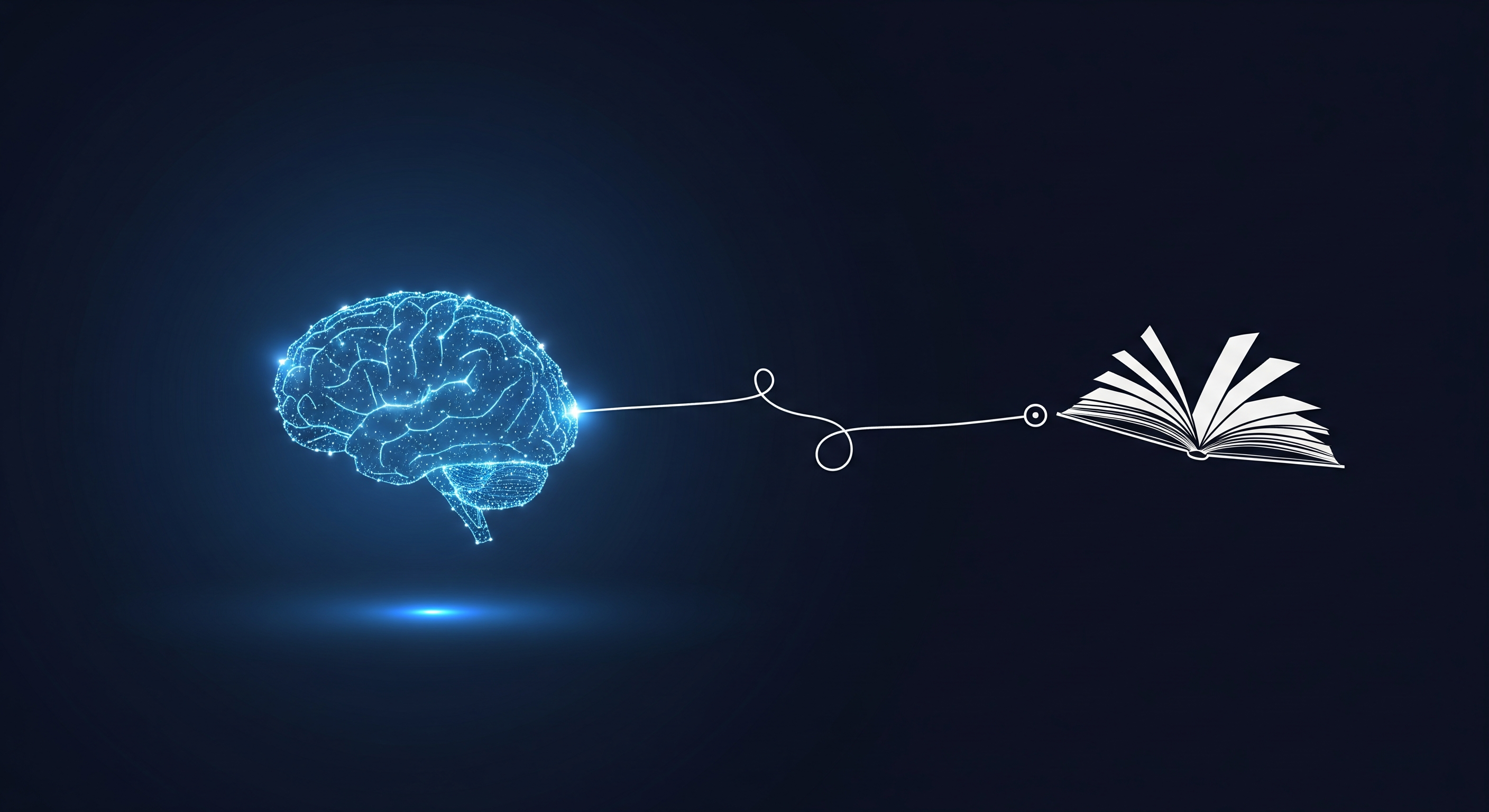
Beyond the Brain: How RAG Gives AI a Library Card to the World's Knowledge
The Narrative Hook: The AI in the Courtroom
Imagine a courtroom where a seasoned judge presides, possessing a profound, almost encyclopedic, understanding of the law. This judge represents a powerful Large Language Model (LLM)—knowledgeable, articulate, and capable of reasoning through a wide array of general legal principles. Now, a highly specialized case is brought forward, one involving obscure patent law and recent, complex precedents. The judge's general knowledge is no longer sufficient to deliver a truly authoritative verdict.
Recognizing this, the judge turns to a diligent court clerk. This clerk doesn’t rely on memory; they sprint to the courthouse’s vast law library. They don't read every book but instead use a hyper-efficient index to find the exact volumes, pages, and paragraphs pertaining to this specific case. Returning moments later with a stack of relevant documents, the clerk presents this precise, factual information to the judge. Armed with this new, specific context, the judge delivers a verdict that is not only eloquent but also meticulously grounded in verifiable fact and legal precedent. This court clerk is Retrieval-Augmented Generation (RAG), the critical process that connects the AI's powerful brain to the world's specific, timely, and authoritative knowledge.
The Core Concept: What is RAG, Really?
Before exploring the intricate mechanics that make RAG a transformative technology, it's essential to grasp the simple, powerful idea at its heart. RAG represents a fundamental shift in how we think about artificial intelligence—a move away from an AI that only knows things from memory to an AI that can actively research and learn in real time. It’s a solution born from a fundamental limitation in even the most advanced models.
Retrieval-Augmented Generation (RAG) is an AI architecture that dramatically enhances a Large Language Model's performance by connecting it to external, up-to-date, or proprietary knowledge bases. Instead of relying solely on the information it was trained on, a RAG-enabled model can "look things up" from a designated library of information before it answers.
The core problem it solves is that standard LLMs, for all their power, have a critical weakness: their knowledge is static. They are trained on vast but finite datasets, creating a "knowledge cutoff" point. Everything they "know" is frozen in the past, making them unable to comment on recent events or access private, specialized information. This limitation leads to outdated answers, an inability to tackle domain-specific questions, and a tendency to "hallucinate"—inventing plausible but incorrect information when they can't find a factual answer in their pre-trained memory.
RAG acts as a bridge over this knowledge gap. When a user asks a question, the RAG system first retrieves relevant, factual information from a connected knowledge source. It then provides this information to the LLM along with the original question. This allows the LLM to formulate its answer based on fresh, accurate, and context-specific data, making its responses vastly more reliable, current, and trustworthy.
Now that we understand what RAG is, let's explore how this revolutionary approach works and why it is conquering some of AI's biggest flaws.
The Deep Dive: Unpacking the RAG Revolution
Understanding the core principles of RAG is not just a technical exercise; it's a strategic imperative for anyone looking to harness the true potential of generative AI. This technology rests on a few key pillars that address the most significant challenges facing AI adoption, turning generalist models into specialized, trustworthy experts.
A. From Guesswork to Ground Truth: Conquering AI's Biggest Flaws
RAG was designed with a clear purpose: to fix the fundamental flaws that make a purely memory-based AI unreliable for mission-critical tasks. It achieves this by transforming how an AI accesses and uses information, addressing four key challenges.
First, RAG directly confronts the problem of AI hallucinations. An LLM operating on its own is like a student relying purely on memory during an open-book exam; if a fact isn't in its memory, it might invent a plausible-sounding answer. RAG mitigates this risk by "anchoring" or "grounding" the model to factual data. Before generating a response, the model is provided with verified, external information, forcing it to base its answer on demonstrable truth rather than statistical guesswork.
Second, RAG shatters the "knowledge cutoff" problem. A standard LLM's knowledge is a snapshot in time, becoming more outdated with each passing day. RAG gives the model a continuous connection to current, real-time information. This could be anything from breaking news for market analysis to the latest policy updates within a company's internal documents. By integrating up-to-the-minute data, RAG ensures an AI’s responses remain relevant and accurate.
Third, RAG unlocks domain-specific expertise. Instead of spending millions on "fine-tuning"—an intensive process of re-educating an entire model on a new dataset—RAG allows a generalist LLM to simply plug into a specialized knowledge base. This empowers organizations to deploy expert-level AI in fields like medicine or finance efficiently and scalably.
Finally, RAG provides a more pragmatic path forward through superior cost and efficiency. The brute-force method of retraining or fine-tuning an LLM to incorporate new knowledge is computationally expensive and resource-intensive. RAG offers a far more economical alternative. Instead of constantly altering the model itself, organizations can simply update the external knowledge base, a much faster and cheaper process. This is a major driver of its rapid enterprise adoption.
While RAG provides a powerful solution, its effectiveness hinges on the quality of the external data. Issues like poor retrieval, latency, and biases inherited from the source documents are critical challenges that developers must actively manage to ensure the system remains reliable and fair.
The "Real World" Analogy: The Connected Academic
Think of a standard LLM as a brilliant academic who has perfectly memorized every book, article, and encyclopedia published up to the year 2021. While immensely knowledgeable, they are now locked in a library with no new information. If you ask about yesterday's market trends or your company's new HR policy, they can only offer educated guesses based on old patterns. RAG is the equivalent of giving that academic a high-speed internet connection, a security key to your company's private digital archives, and a real-time news ticker. Suddenly, they can answer questions with up-to-the-minute, context-specific knowledge, transforming from a historian into a dynamic, living expert.
The "Zoom In": Building User Trust Through Citations
Perhaps the most critical feature of RAG for enterprise adoption is its ability to build user trust. Because the RAG model retrieves information from specific sources before generating an answer, it can provide citations for its claims, much like footnotes in a research paper. When a user receives an answer, they also see a link to the original document, policy, or data source. This is a game-changer. It allows human users to verify the AI's output, confirm its accuracy, and dig deeper into the source material if needed. For businesses operating in regulated or high-stakes environments, this verifiability moves generative AI from a curious novelty to a reliable, auditable business tool.
Having established the problems RAG solves, let's look under the hood at the elegant architecture that makes it all possible.
B. The Digital Librarian: Inside the RAG Architecture
At its core, a RAG system operates in two primary phases: an initial setup phase where it organizes its knowledge, and a real-time operational phase where it answers questions. This process is much like a highly advanced librarian preparing and using a library.
Phase 1: Ingestion (Stocking the Library) The first phase is ingestion, which is all about preparing the external knowledge for the AI. This process begins by taking a vast collection of data—PDFs, documents, websites, databases—and breaking it down into smaller, manageable "chunks." This chunking is crucial because it helps ensure that the retrieved information will not overwhelm the "context window," or short-term memory, of the LLM. These chunks are then processed by an "embedding model," which converts the text into a numerical representation called a vector. This vector captures the semantic meaning of the text, allowing the system to understand concepts and context, not just keywords. These vectors are then stored and indexed in a special kind of repository called a vector database.
Phase 2: Retrieval & Generation (Answering the Question) The second phase, retrieval and generation, happens every time a user submits a prompt. The process begins by converting the user's query into a vector using the same embedding model. The system then uses this query vector to search the vector database, looking for the text chunks with the most similar embeddings. This is a "semantic search"—it finds information based on meaning, not just word-for-word matches. Once the most relevant chunks of information are retrieved, the system "augments" the original user prompt by adding this new context. Finally, this expanded prompt is sent to the LLM, which generates a final, informed answer based on both the user's question and the factual data it was just provided.
The "Real World" Analogy: The Magical Librarian
Imagine a digital librarian tasked with organizing a new library. During the ingestion phase, this librarian doesn't just place books on shelves. They meticulously read every single document, article, and report. For every important concept, they create a hyper-detailed index card that captures its true meaning (an "embedding"). They then file these cards in a special, enchanted cabinet (a "vector database") where cards with similar meanings are magically drawn together, regardless of the exact words used. The retrieval phase begins when you ask a question. The librarian instantly converts your question into a new index card, finds all the matching cards in the cabinet, pulls the corresponding books and documents from the shelves, and synthesizes the perfect, evidence-backed answer for you on the spot.
The "Zoom In": Embeddings and Vector Databases
The magic behind RAG's intelligent search capability lies in Embeddings and Vector Databases. An "embedding model" is a specialized neural network that acts as a universal translator, turning human language into a language machines can understand: numbers. It transforms a piece of text into a high-dimensional vector—a long list of numbers—where the position and direction of the vector represent the text's semantic meaning. Words and sentences with similar meanings will have vectors that are "close" to each other in this mathematical space. A vector database is a database specifically designed to store these vectors and perform incredibly fast similarity searches. When your query is converted into a vector, the database doesn't look for keyword matches; it looks for the vectors that are mathematically closest to your query's vector. This is what enables the system to find a paragraph about "employee travel stipends" even if your query only asked about "getting paid for meals on a business trip."
With this architectural understanding, let's explore the concrete ways enterprises are putting this technology to work.
C. Powering the Enterprise: RAG in the Real World
By bridging the gap between general AI and specific data, RAG is unlocking a new wave of practical, high-value applications across industries. These aren't futuristic concepts; they are real-world tools being deployed today to enhance productivity, empower employees, and create better customer experiences.
First, RAG is a powerful tool for customer and employee empowerment. Companies are building specialized customer service chatbots that can access up-to-the-minute product information and company policies to provide accurate, personalized support. Internally, RAG powers sophisticated knowledge engines that act as virtual experts. This directly solves the domain-specific expertise problem, allowing a general LLM to become an instant expert on complex internal policies without costly retraining and equipping employees with the exact technical information they need.
Second, RAG is transforming high-stakes professional work. In finance, analysts use RAG-powered assistants to query real-time market data alongside historical reports. In medicine, professionals can conversationally query vast repositories of patient records and institutional knowledge. For content creators, RAG provides a reliable way to generate articles grounded in authoritative sources. These applications are built on trust, as the ability to cite sources directly mitigates the risk of hallucinations in critical fields.
Third, RAG is becoming a key asset for business strategy and development. By connecting to live data streams, these systems can analyze market sentiment from social media, track competitor activity, and reference customer feedback for product development. This application shatters the knowledge cutoff problem by connecting the LLM to live information, allowing leaders to make faster, more informed decisions based on the most current data available.
The "Real World" Analogy: The Corporate Super-Assistant
Picture a Corporate Super-Assistant. This assistant has flawlessly read and remembered every internal policy manual, every customer feedback form, every sales report, and every market analysis the company has ever produced. It also reads all relevant industry news and social media conversations in real-time. When a manager asks a complex strategic question like, "Based on recent customer complaints on Twitter and Competitor X's new product launch, what should our top R&D priority be for the next quarter?", this super-assistant doesn't just give an opinion. It instantly synthesizes all the relevant data points—the specific customer feedback, the features of the competitor's product, and internal R&D capacity reports—to provide a comprehensive, evidence-backed recommendation, complete with links to all its sources. That is what RAG enables.
The "Zoom In": The Drafting Assistant
A standout use case is the RAG-powered Drafting Assistant. Consider an employee tasked with writing a quarterly performance report—a task that typically involves days of hunting down data from different systems. With a RAG tool, the employee simply initiates the document. The system automatically queries enterprise databases for the latest sales figures, pulls key insights from past reports, and checks internal policy documents for formatting guidelines. It then prepopulates entire sections of the new report with accurate, cited information. The employee's role shifts from data hunter to strategic editor, transforming a multi-day task into a matter of hours.
Now, let's walk through the complete journey of a single query to see how all these pieces come together in a seamless flow.
A Day in the Life of a Query: A Step-by-Step Walkthrough
To truly understand how RAG works, let's follow a single question on its journey through the system. We'll trace its path from the moment a user types it in to the moment a sophisticated, fact-checked answer appears on their screen. This step-by-step process reveals the elegant coordination that makes the magic happen.
The Scenario: An employee at a large company, named Alex, is planning a trip for a project in a new country. Alex needs to know the company's official policy on international business travel, specifically regarding daily expense limits.
The Walkthrough:
- The Prompt is Submitted: Alex opens the company's internal knowledge chatbot and types in a simple question: "What is the policy on international business travel and per diems?"
- The Query is Encoded & Retrieved: Instantly, the RAG system takes Alex's question and sends it to an embedding model. The model converts the text into a numerical vector that captures its semantic meaning. This vector is then used to search the company's vector database, which contains indexed chunks from all relevant corporate documents: HR policies, travel guidelines, and financial procedures. The database identifies the document chunks whose vectors are most similar to Alex's query vector.
- Relevant Information is Returned: The retriever model pulls the most relevant chunks of text from the database. In this case, it finds the specific paragraphs detailing the international travel approval process, the section on per diem rates for different countries, and the guidelines for submitting expenses.
- The Prompt is Augmented: This is the crucial step. The system does not send Alex's original, simple question to the LLM. Instead, it constructs a new, augmented prompt that combines the original question with the factual context it just retrieved. The new prompt looks something like this:
"You are a helpful HR assistant. Answer the user's question about international travel using only the following context: [Insert Retrieved Policy Text Here].
User Question: What is the policy on international business travel and per diems?"
- The Final Answer is Generated: The LLM receives this rich, detailed prompt and generates a comprehensive answer based only on the information provided. It synthesizes the retrieved chunks into a clear, coherent response for Alex, explaining the approval process, how per diems are calculated, and the rules for expense reporting. Crucially, the answer may also include citations (e.g., "See HR Policy 7.4.1 for more details"), pointing Alex directly to the full source documents for verification.
The RAG Rosetta Stone: An ELI5 Dictionary
The world of AI is filled with technical jargon. This section breaks down the key terms behind RAG into simple, easy-to-understand translations.
-
Retrieval-Augmented Generation (RAG) Think of it as... giving an AI a library card and the ability to look things up before answering your question.
-
Large Language Model (LLM) Think of it as... the AI's "brain," which has a general understanding of the world based on the books it has already read.
-
Hallucination Think of it as... the AI confidently making something up because it can't find the right answer in its memory.
-
Embeddings Think of it as... a secret code for words. Words with similar meanings have similar codes, making them easy for a computer to group together.
-
Vector Database Think of it as... a special library where books are organized by topic and meaning, not by alphabet, so you can find all books about "bravery" even if they don't use that exact word.
-
Fine-Tuning Think of it as... sending a general-practice doctor to medical school again to become a heart surgeon. It's an intensive process to change the model itself.
-
Parameterized Knowledge Think of it as... everything the AI "knows" from memory, without having to look anything up.
Conclusion: From a Static Brain to a Dynamic Assistant
Our journey has shown that while Large Language Models are incredibly powerful, their reliance on static, "parameterized" knowledge creates fundamental flaws. We've seen that a purely memory-based intelligence can be outdated, lack specific expertise, and even invent facts. Retrieval-Augmented Generation provides the missing piece of the puzzle, transforming these generalist models into trusted, verifiable experts by anchoring their vast reasoning abilities to a foundation of ground truth. This marks the pivotal shift from an AI that merely knows to one that can research.
The evolution of this technology is already pointing toward an even more sophisticated future. The rise of agent-based RAG and LLMs specifically optimized for retrieval signals the next step: creating truly autonomous assistants that can reason, interact with data, and perform complex tasks with less human intervention.
Ultimately, RAG is fundamentally changing our relationship with artificial intelligence. We are moving beyond the old paradigm of conversing with a model's frozen memory and are stepping into a new era of collaborating with a real-time researcher—one that can have a dynamic conversation with the world's collective, living knowledge.