Beyond the Basics: The Art and Science of Fine-Tuning AI
The Narrative Hook: From Generalist Robot to Master Craftsman
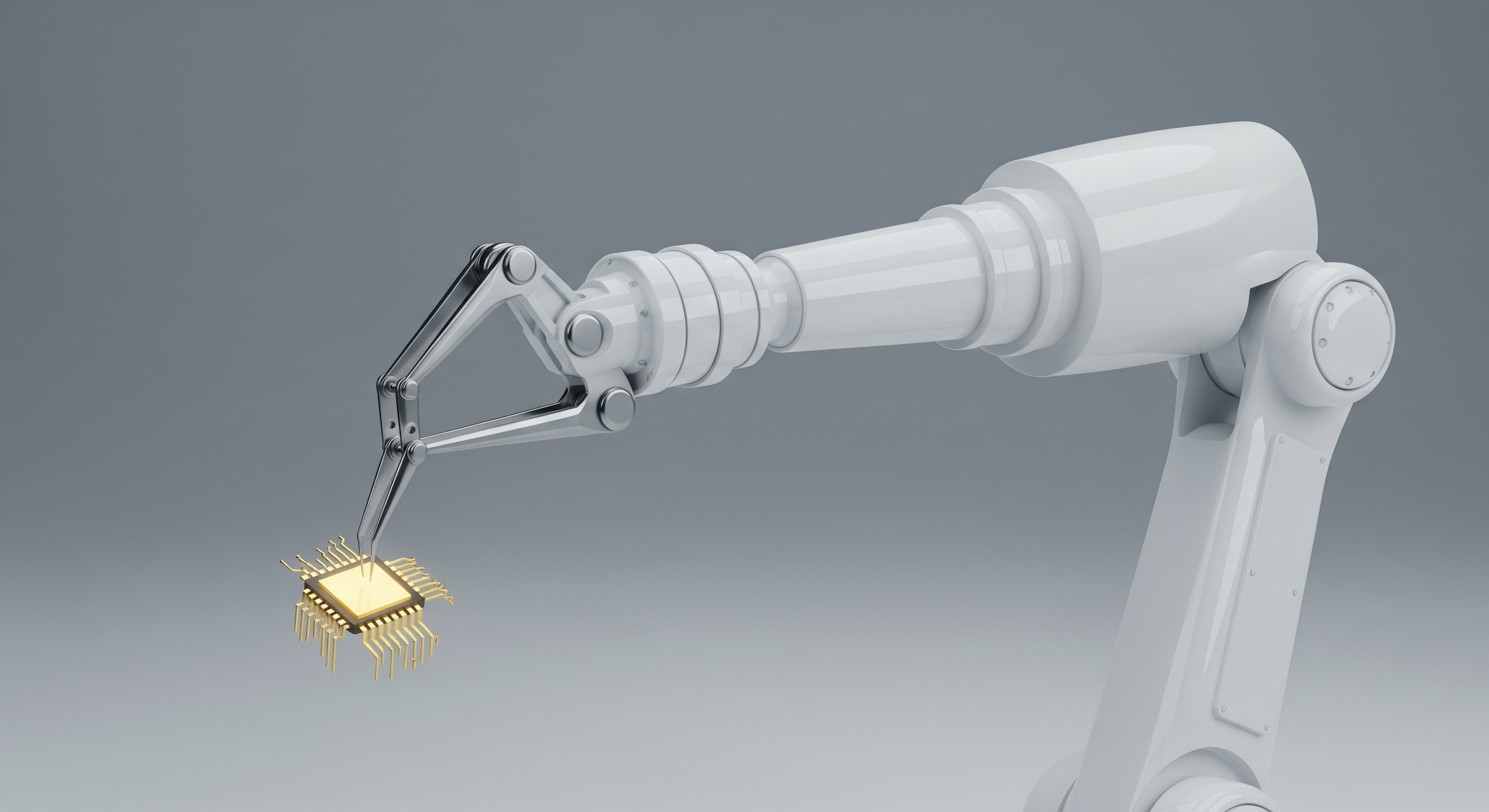
Imagine a state-of-the-art factory floor, gleaming under bright industrial lights. A massive, powerful robotic arm has just been installed. It arrives pre-programmed with an impressive range of general movements—it can lift, pivot, and extend with incredible force. Yet, for the factory's specific purpose of assembling delicate microchips, it is utterly useless. Its movements are clumsy, its force is excessive, and it lacks the nuance required for the task. Before it can contribute, engineers must spend time calibrating it, using a small set of the actual microchips to teach it the precise pressure, angle, and speed required. They are not rebuilding the robot or teaching it robotics from scratch; they are honing its vast potential for a single, specialized purpose.
This transformation—from a powerful generalist into a master craftsman—is a perfect metaphor for one of the most crucial processes in modern artificial intelligence: fine-tuning. Just like the robotic arm, the most powerful AI models arrive with a broad, generalized education about the world. But to make them truly useful for solving specific, real-world problems, we must carefully calibrate and specialize them. This article will demystify this essential process, explaining how we teach a generalist AI to become an expert.
The Core Concept: What Exactly Is Fine-Tuning?
In the world of artificial intelligence, creating a new, powerful model from a blank slate is an undertaking of monumental expense and time. The true strategic advantage lies not in starting over for every new problem, but in intelligently adapting what already exists. Fine-tuning is the essential bridge between a powerful, general-purpose AI and a useful, specialized tool. It is the process that allows organizations to customize sophisticated models for their unique needs without the prohibitive cost of building from the ground up.
A. The Big Picture Definition
Fine-tuning is the process of adapting a pre-trained model for a specific task or use case. It is a subset of a broader machine learning technique called transfer learning, which is the practice of leveraging knowledge an existing model has already learned as a starting point for a new task.
The core value proposition is simple but profound: it is significantly easier, cheaper, and faster to hone an existing model's broad knowledge than it is to train a new one from scratch. This is especially true for today's foundation models, like Large Language Models (LLMs), which contain billions of parameters and represent an immense initial investment in data and computation.
B. The Key Analogy: Building on a Foundation
Transfer learning provides the foundation upon which fine-tuning builds. A pre-trained model has already spent months or even years learning the fundamental patterns of its domain—a language model has learned grammar, context, and semantics, while an image model has learned about shapes, textures, and objects.
The "Real World" Analogy: The Specialist Doctor
Think of it like a human expert. A doctor aspiring to become a pediatric cardiologist doesn't re-learn basic biology, chemistry, and anatomy. They build their highly specialized knowledge upon the vast foundation of their general medical degree. The pre-trained AI model is like the doctor with a medical degree; it has a powerful, generalized understanding. Fine-tuning is the AI's equivalent of a medical residency or fellowship—a focused period of training that makes it an expert in a specific field.
To truly appreciate this specialized training, however, we must first understand the monumental process it builds upon: the AI's "university education," known as pre-training.
The Deep Dive: How an AI Gets Its Education
An AI model’s "education" is a tale of two phases: a broad, general education where it learns the fundamentals of its domain, and a specialized vocational training where it masters a specific job. The first phase, pre-training, is a resource-intensive marathon. The second, fine-tuning, is a comparatively efficient sprint. Understanding this distinction is critical to appreciating how we create truly intelligent and useful AI systems.
A. Phase 1: The "University" Years – Pre-Training from Scratch
Forging a Mind: The Monumental Task of Pre-Training
At the very beginning, a model is a blank slate. Its neural network is a complex web of connections, but the values that govern those connections—its parameters (weights and biases)—are initialized randomly. It has not yet "learned" anything. The pre-training process teaches the model by iteratively adjusting these parameters in two repeating steps:
- The Forward Pass: The model is fed a sample from a massive dataset and makes a prediction.
- Backpropagation: An optimization algorithm—typically gradient descent—is used to measure the "loss" (the difference between the model's prediction and the correct answer) and adjust the model's weights across the entire network to reduce this error.
This process is repeated across trillions of data points. For LLMs, this is typically done through self-supervised learning (SSL). This ingenious method allows the model to learn from vast amounts of unlabeled text by performing a "pretext task." These tasks often take two forms: self-prediction, where the model predicts a masked part of an input (like the next word in a sentence, used by autoregressive models like GPT and Llama), and contrastive learning, which teaches the model to understand similarity (used in models like CLIP). The original data itself provides the "correct" answers, eliminating the need for costly human annotation.
The "Real World" Analogy: Reading the Library
Pre-training is like a person learning a language for the first time by being tasked with reading an entire library. They aren't trying to write an essay or answer a specific question. They are simply absorbing the fundamental rules of grammar, vocabulary, context, and sentence structure by observing trillions of examples of how words fit together. This process builds a deep, intuitive understanding of the language itself.
The sheer scale of pre-training is staggering. It involves models with billions of parameters being trained on trillions of bytes of data, requiring immense computational power and taking months or even years to complete. This is why building a foundation model from scratch is a feat only a handful of organizations can undertake. While this "university education" creates a knowledgeable model, it's not yet ready for a specific job.
B. Phase 2: The "Apprenticeship" – Fine-Tuning for a Specific Job
Honing the Craft: The Art of Specialization
Fine-tuning begins where pre-training leaves off, but the process is fundamentally different. Instead of starting with random parameters, it starts with the fully pre-trained weights of the foundation model. And instead of using a massive, general dataset, it uses a much smaller, specialized dataset tailored to the new task.
This approach neatly avoids a critical pitfall. If you were to train a large, complex model from scratch on only a small dataset, it would likely lead to overfitting. The model would essentially memorize the training examples but fail to generalize its knowledge to new, unseen data, making it useless for its intended purpose.
Fine-tuning provides the best of both worlds. It leverages the broad knowledge and stability gained from pre-training on a massive dataset while using a curated dataset to hone the model’s understanding of more detailed, specific concepts.
The "Real World" Analogy: Calibrating the Robot
Let's return to our factory robot. Its pre-training is its general, factory-installed knowledge of movement. The fine-tuning is the specific calibration on the assembly line. Engineers use a small set of the actual products the robot will handle to teach it the precise pressure, angle, and speed required for its job. It builds upon its general capabilities to master a specific craft.
A clear use case is fine-tuning a general LLM for coding. The smaller, task-specific dataset would consist of pairs of programming requests (e.g., "Write a Python function to sort a list") and the corresponding correct code snippets. This process teaches the model the specific patterns and syntax of this new "language," transforming it into a capable coding assistant. Now that we understand the what and why of fine-tuning, let's explore the how.
The Fine-Tuner's Toolkit: A Spectrum of Techniques
Just as a master craftsman has a toolkit with different instruments for different jobs—from a heavy sledgehammer to a delicate chisel—an AI engineer has a range of fine-tuning techniques. These methods span from computationally intensive overhauls of the entire model to lightweight, precise adjustments, allowing for a tailored approach based on the task and available resources.
A. The Sledgehammer: Full Fine-Tuning
This is the most straightforward approach. The training process continues just as it did during pre-training, but with the new, specialized dataset. In this method, all of the model's billions of parameters are updated.
While conceptually simple, this method is computationally demanding and can lead to "catastrophic forgetting," a phenomenon where learning the new task destabilizes or erases the model's original broad knowledge. Furthermore, because it updates all weights, each new fine-tuned task creates a full-sized copy of the model, making it storage-intensive to maintain multiple specializations. To mitigate these risks, engineers often adjust hyperparameters, for instance, by using a much smaller learning rate to make the changes less disruptive.
B. The Precision Tools: Parameter-Efficient Fine-Tuning (PEFT)
To address the costs and risks of full fine-tuning, a family of more sophisticated methods called Parameter-Efficient Fine-Tuning (PEFT) has emerged. The core idea of PEFT is to reduce computational and memory costs by freezing most of the original model's parameters and updating only a small, select subset.
The Sculptor's Chisel: Selective Layer Tuning This is the most intuitive PEFT approach. It involves updating only a portion of the model's existing layers, typically the outermost ones. In most neural networks, the inner layers capture broad, generic features (like edges and textures in an image model), while the outer layers handle more task-specific features. By freezing the inner layers, we preserve the model's core knowledge while adapting its final output layers to the new task.
The Extension Pack: Adding New Modules Rather than changing any of the model's original parameters, this additive method adds new, trainable components. One popular technique involves injecting small adapter modules—new, task-specific layers—between the existing layers of the model. Famously demonstrated on the BERT language model, this approach freezes the entire original model and trains only these new, compact modules. Another branch of this method is prompt tuning, which freezes the model and instead trains AI-authored "soft prompts"—learnable vectors that are added to the user's input to guide the model's output more effectively.
The Smart Edit: Training the Changes, Not the Text Perhaps one of the most powerful PEFT methods is Low-Rank Adaptation (LoRA). Instead of directly changing the model's massive weight matrix, LoRA trains a much smaller matrix of updates (or "delta weights").
The "Real World" Analogy: Track Changes
Think of editing a large document using "Track Changes." Instead of saving a full, brand-new copy of the document for every minor edit, the software only stores a small list of the changes themselves. LoRA operates on a similar principle, training and storing only the compact "delta" of changes.
This approach dramatically reduces the number of trainable parameters. A major benefit is that these small "delta" files can be swapped in and out, allowing a single base model to be quickly adapted for many different specialized tasks. A popular derivative, QLoRA, enhances efficiency even further by using quantization to reduce the numerical precision of the model's weights before fine-tuning.
These tools, from the sledgehammer to the scalpel, are not just theoretical; they are applied daily in a structured, methodical pipeline to bring real-world AI applications to life, as we'll see next.
A Step-by-Step Walkthrough: Bringing a Financial Chatbot to Life
To ground these abstract concepts, let's walk through a practical scenario where the fine-tuner's toolkit is put into practice. Imagine a financial services company wants to create a specialized chatbot. Its purpose is to answer customer questions about the company's proprietary investment products, using the firm's specific brand voice and tone. Here is the seven-stage pipeline they would follow to achieve this using fine-tuning.
- Stage 1: Data Preparation The team begins by collecting and cleaning internal documents, past customer service chat logs, product brochures, and marketing materials. This creates a high-quality, curated dataset of potential customer questions and the ideal, on-brand answers.
- Stage 2: Model Initialization Next, they select a powerful, open-source foundation model, such as Meta's Llama 2, from a repository like Hugging Face. They load this pre-trained model into their secure cloud environment, ready for customization.
- Stage 3: Training Setup The data scientists carefully set the key hyperparameters. They define the learning rate, the batch size (how many examples are processed at once), and the number of epochs (passes through the training data) to ensure the model learns efficiently without forgetting its general language knowledge.
- Stage 4: Fine-Tuning the Model This is where a choice from our toolkit is made. The team selects a PEFT method like LoRA to efficiently adjust a small subset of the model's parameters as it processes the company's curated data. This step teaches the model the nuances of the company's products and communication style.
- Stage 5: Evaluation and Validation The newly tuned chatbot is tested on a separate set of unseen questions (the "validation set"). The team measures its accuracy, precision, and recall to ensure it is not providing incorrect financial information or deviating from the brand voice. This crucial step tests the model's ability to generalize its new knowledge rather than simply memorizing the training examples, which helps avoid overfitting.
- Stage 6: Deployment Once the model performs satisfactorily, it is integrated into the company's production environment, such as the chat interface on their website. Security measures like encryption and access control are implemented to protect the model and user data.
- Stage 7: Monitoring and Maintenance This is an ongoing process. The team continuously tracks the chatbot's performance in the real world. If new investment products are launched, they will repeat the process from Stage 1, using new data to update the model's knowledge and keep it relevant.
The AI Conversation Coach: Fine-Tuning for Dialogue
For LLMs to be truly useful in applications like chatbots, they need more than just knowledge. They must understand human intent and adhere to abstract qualities like helpfulness, safety, and factual accuracy. The raw, pre-trained models often lack this alignment. Two key fine-tuning techniques are used to coach them into becoming better conversational partners.
A. Teaching by Example: Instruction Tuning
A pre-trained LLM is fundamentally a text-completion engine. If prompted with "teach me how to make a resumé," it might simply complete the sentence with a grammatically correct but unhelpful phrase like "using Microsoft Word." It has completed the sequence, but it has not followed the user's implicit instruction.
Instruction Tuning—a form of Supervised Fine-Tuning (SFT)—solves this. It involves fine-tuning the model on a dataset of labeled examples in a (prompt, response) format. These examples demonstrate the desired pattern: a prompt containing an instruction and a response that correctly fulfills it. By training on thousands of such examples (e.g., questions with answers, text to be summarized with its summary), the LLM learns the general pattern of how to follow instructions and provide useful, goal-oriented answers.
B. Teaching by Preference: Reinforcement Learning from Human Feedback (RLHF)
While instruction tuning is great for concrete tasks, it's very difficult to teach abstract qualities like "helpfulness," "humor," or "harmlessness." These qualities are subjective, and this is where models face existential challenges like hallucinations (making things up) or reflecting biases. How do you create a dataset of "funny" jokes when humor is so personal?
Reinforcement Learning from Human Feedback (RLHF) offers an elegant solution. It fine-tunes a model based on what humans prefer, rather than on "correct" answers. The process works in a clear causal chain:
- Generate Responses: An instruction-tuned model is used to generate multiple different responses to a set of prompts.
- Rank Responses: Human testers are shown these responses and rank them from best to worst based on criteria like helpfulness, truthfulness, and safety.
- Train a Reward Model: This collection of human preference data is used to train a separate "reward model." The reward model's only job is to look at a response and predict the score a human would give it.
- Fine-Tune the LLM: Finally, this reward model acts as an automated judge. The original LLM is fine-tuned further using reinforcement learning, getting "rewarded" for producing outputs that the reward model scores highly. This process reinforces behaviors that align with complex human preferences.
The ELI5 Dictionary: Key Terms Unpacked
Every specialized field has its own lexicon, and artificial intelligence is no different. To ensure you leave with a clear understanding, here is a quick "Explain Like I'm 5" dictionary for the most important terms we've covered, translating the technical jargon into simple, memorable ideas.
-
Catastrophic Forgetting The phenomenon in which fine-tuning causes the loss or destabilization of the model’s core knowledge. In simple terms: Think of it as a brilliant historian who specializes so intensely in the Napoleonic Wars that they begin to forget the key dates of the American Revolution.
-
Hyperparameters Model attributes that influence the learning process but are not themselves learnable parameters, such as learning rate or batch size. In simple terms: These are like the settings on an oven (temperature, cooking time) that you have to choose before you start baking. You adjust them to get the perfect result, but they aren't an ingredient in the cake itself, just as hyperparameters aren't learned by the model.
-
Overfitting When a model learns to perform well on training examples but generalizes poorly to new data. In simple terms: It's like a student who memorizes the exact answers to a specific practice test but hasn't actually learned the subject. When they face the real exam with slightly different questions, they fail.
-
Reinforcement Learning from Human Feedback (RLHF) A process that uses human preferences to train a reward model, which in turn is used to fine-tune an LLM to align with complex human qualities. In simple terms: It's like training a puppy. Instead of just showing it a picture of a "good dog," you give it a treat every time it does the right thing (like sitting on command). The "treats" (positive feedback) guide its behavior over time.
-
Low-Rank Adaptation (LoRA) A reparameterization-based PEFT method that optimizes a matrix of updates to model weights rather than the weights themselves, greatly reducing trainable parameters. In simple terms: Instead of saving a whole new version of a 1,000-page book every time you make an edit, you just save a tiny file that lists the changes (e.g., "Page 52, change 'cat' to 'dog'"). It's vastly more efficient.
Conclusion: From General Knowledge to Specific Wisdom
We began our journey with the image of a powerful but clumsy robotic arm, a generalist tool waiting for a specific purpose. Throughout this article, we've seen how fine-tuning is the critical calibration process that transforms that general potential into specialized mastery. It takes the broad, foundational knowledge of a pre-trained AI—its "university education"—and puts it through a focused "apprenticeship," teaching it the specific skills needed to excel at a particular job.
The key takeaway is that the true power of modern AI lies not just in the creation of massive foundation models, but in our ability to efficiently and effectively adapt them. Through a sophisticated toolkit ranging from full fine-tuning to precise, parameter-efficient methods like LoRA, we can instill specialized expertise, align models with human values through RLHF, and prepare them for real-world deployment.
Ultimately, fine-tuning is a democratizing force. This adaptability—not just the raw power of the base models—is what unlocks bespoke innovation. By dramatically lowering the cost and technical barriers to customization, fine-tuning empowers more organizations, researchers, and creators to harness sophisticated AI for unique challenges in fields as diverse as medicine, finance, and the creative arts. It is the crucial technique that transforms general knowledge into specific wisdom, truly putting the power of AI into the hands of problem-solvers everywhere.