The AI Co-Pilot: How Human Creativity Became the Most Valuable Skill in Design
The Narrative Hook: A Tale of Two Pixels
Before the dawn of generative artificial intelligence, much of a graphic designer’s day was spent in the digital trenches, engaged in a painstaking, pixel-by-pixel battle with the mundane. Imagine the task of removing the background from a complex photograph—a model with windswept hair, for instance. This was a job of meticulous, manual pathing, a slow and steady process of tracing, selecting, and deleting that could consume hours. Each click was a small victory, but the cumulative effort was a significant drain on a designer’s most precious resource: their creative energy. This tedious reality was not a niche problem; it was a universal tax on the creative process.
Now, consider a modern graphic designer faced with the same challenge. Instead of settling in for a long session of tedious clicking, she opens Adobe Photoshop, selects the subject with a rough outline, and engages a single command: Content-Aware Fill. In seconds, the background vanishes, seamlessly replaced by an intelligent reconstruction of what should lie behind it. The entire process takes less time than it takes to brew a cup of coffee. This isn't just a software update; it's a seismic shift in the very nature of creative work. The machine has mastered a task that once defined a part of the craft. This powerful new reality prompts a fundamental and unsettling question for every creative professional: if the machine can handle the craft, what is left for the artist?
This leap in technological capability has thrust the design community into a fierce debate, forcing us to explore whether this new power is an existential threat or the greatest tool ever placed in the hands of a designer.
The Core Concept: The Answer Isn't 'If', It's 'How'
A current of anxiety ripples through the creative industries, sparking conversations that swing wildly between utopian dreams and dystopian nightmares. For designers, the core question—"Will AI replace me?"—has become a source of genuine concern. But framing this as a simple yes-or-no question misses the point. To truly understand this moment, we must recognize where we stand on the timeline of technological progress. Right now, we are at the "Nokia 5110 of AI progression." The technology is impressive, even game-changing, but it is a primitive ancestor of what is to come. We are at the very beginning of the S-curve of technological advancement, where progress is exponential and intuition fails us.
So, will AI replace graphic designers? The consensus from across the industry is a clear and resounding no. However, the role of a graphic designer is undergoing a fundamental and irreversible transformation.
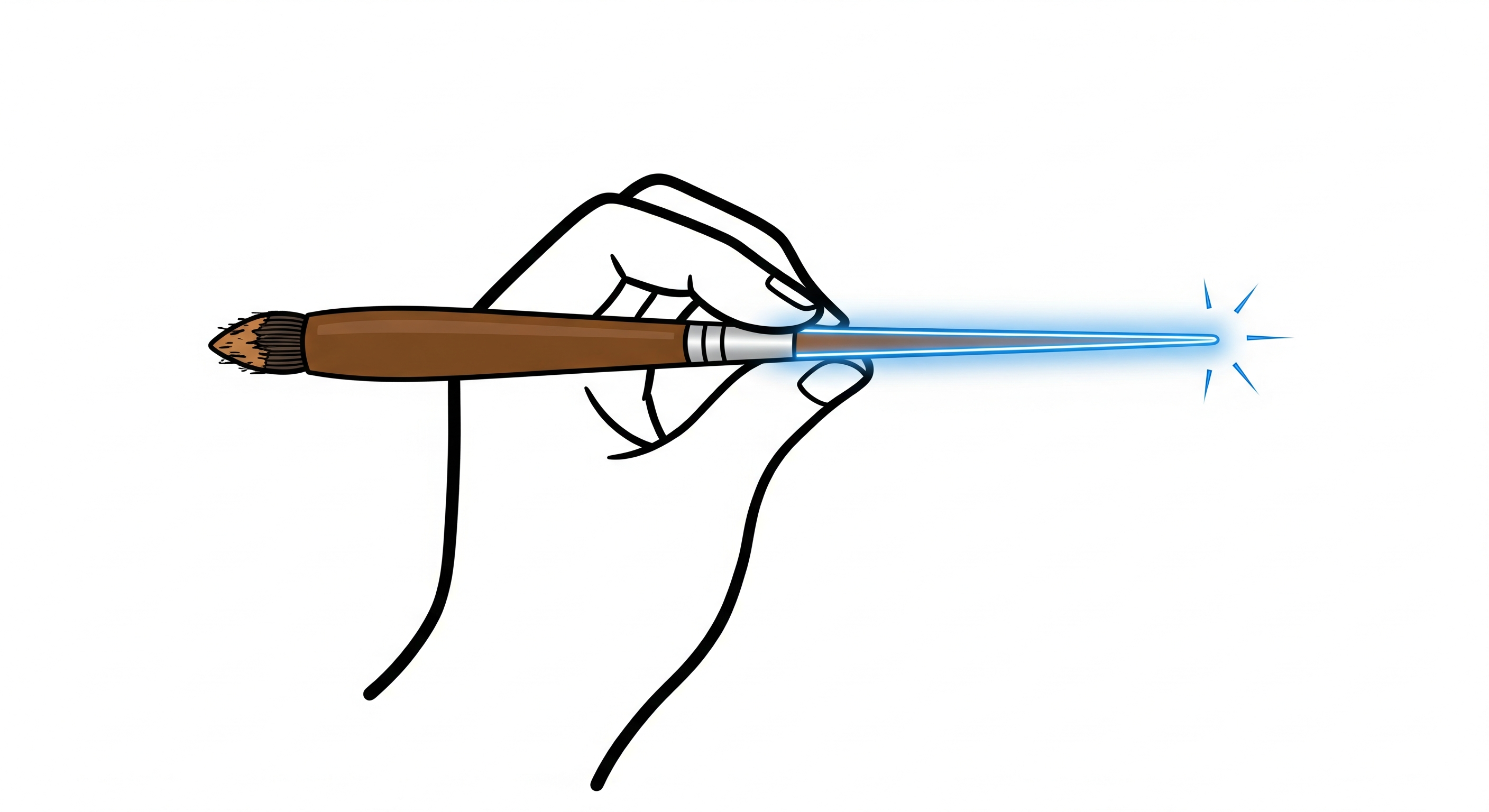
The most accurate way to understand this shift is to view AI not as a competitor, but as a collaborator—a hyper-efficient assistant that handles the laborious parts of the job. It’s like a painter suddenly getting a new kind of brush that can generate a thousand landscapes in seconds. The painter still has to choose the one that hits the right emotional note and tells the right story. In this new partnership, AI handles the "how"—the technical execution of generating visuals with incredible speed. The human designer, however, remains firmly in charge of the "why"—the strategy, emotional connection, cultural nuance, and purpose that give a design meaning.
To truly understand this new partnership and how to thrive within it, we must first break down what AI can—and, more importantly, what it cannot—do.
The Deep Dive: Unpacking the New Digital Toolkit
The Hyper-Efficient Junior Designer: What AI Excels At
The most immediate and transformative impact of AI on the design world is its ability to absorb and automate high-volume, repetitive work. This is strategically vital because it liberates a designer's most valuable and finite resource: their time for deep, creative, and strategic thinking. AI acts as a tireless assistant, perfectly executing the tasks that once consumed the bulk of a designer's day.
Its most obvious benefit lies in the automation of mundane tasks. Tools like Adobe's Content-Aware Fill can remove unwanted elements from an image in a single click, a job that once required painstaking manual effort. AI can also instantly resize entire suites of images for different platforms, adjust color schemes across a campaign, and generate mockups without the need for a professional photoshoot.
Beyond mere automation, AI can serve as a powerful brainstorming partner when creative block strikes. Platforms such as MidJourney, DALL-E, Artbreeder, and Runway ML can generate a flood of unique visual concepts based on a simple text prompt. This allows designers to explore a massive range of possibilities and discover new stylistic combinations almost instantly, pushing their creative boundaries.
The "Real World" Analogy: The Master Chef's Kitchen
To understand AI's role in the design process, it's best to leave the design studio and enter a master chef's kitchen. Here, the AI acts as a highly skilled kitchen staff, able to perfectly chop every vegetable, prepare complex sauces, and handle all the laborious prep work at incredible speed and scale. This frees the master chef—the human designer—from the grunt work. However, it is the chef who holds the recipe, understands the delicate balance of flavors, knows the story behind the dish, and plates the final creation with artistry and intention. The AI prepares the ingredients, but the chef creates the masterpiece.
Nowhere is this shift more apparent than in the simple, yet revolutionary, power of rapid asset variation. A designer creates a single, master social media ad. In the past, they would then face hours of what one source calls "tedious" and "low-creativity" work: manually resizing and reformatting that ad for five different platforms. Today, an AI can take that single master design and instantly generate every required variation, perfectly adjusting the layout and typography for each platform's unique dimensions. This single function transforms days of work into minutes, freeing the designer to focus on the campaign's overarching strategy.
The Ghost in the Machine: Where Human Creativity Reigns Supreme
To understand the future of design, it is more important to know what AI cannot do than what it can. These limitations are not a critique of the technology but a clear definition of the protective "moat" around human creativity. The gaps in AI's capabilities are precisely where designers will build their future value and prove their indispensability.
Despite its processing power, AI cannot replicate empathy, cultural nuance, or humor. It doesn’t understand why a certain font feels comforting or why a specific color might be celebrated in one culture but offensive in another. This leads to frequent misinterpretations of prompts, where AI produces designs that are technically correct but emotionally vacant or contextually inappropriate. An AI doesn't understand that a fun, rounded font perfect for a children's book would be a brand-killing disaster for a corporate law firm.
Perhaps most critically, AI can execute a task perfectly but has "no intention." It has zero understanding of business goals, audience psychology, or the strategic purpose behind a design. It can generate a logo, but it cannot sit with a startup founder, understand their passion, and translate that fire into a visual identity that resonates with a specific market. This ability to link visuals to a deeper strategic mission is a purely human endeavor.
The "Real World" Analogy: The Linguist vs. The Poet
An AI in design is like a brilliant linguist who has memorized an entire dictionary but has never had a conversation. The AI knows all the words (visual elements) and all the grammar rules (design principles). It can construct technically perfect sentences. However, it cannot tell a compelling story, understand a subtle joke, write a moving poem, or feel the emotional weight of the words it uses. That requires lived experience, consciousness, and empathy—the exclusive domain of the human designer.
This limitation is thrown into sharp relief by one of the most common and challenging pieces of client feedback: the vague, emotional request, "Can you make it pop more?" An AI, as one source notes, is "totally stuck" by this. It needs literal, precise commands. In contrast, a human designer thrives in this gray area. They use their experience, intuition, and clarifying questions to translate that abstract feeling into concrete design changes.
The New Job Title: Rise of the AI Art Director
The integration of AI into the creative process necessitates a fundamental career adaptation for every designer. This evolution is best understood through the powerful distinction between a "design tinkerer" and a "design thinker." The design tinkerer—one who relies on trial and error until something looks good—will be easily replaced. AI can tinker faster and produce more options than any human. The design thinker, however, becomes more valuable than ever before. This is the designer who leads with strategy, empathy, and a deep understanding of business goals. The most important career shift a designer must make is from tinkerer to thinker, from hands-on producer to high-level creative director.
The "Real World" Analogy: The Film Director
The new role of the design thinker is best understood by comparing it to that of a film director. A director doesn't personally operate the camera, design the sets, or apply the actors' makeup. Instead, they hold the overarching vision for the story. They guide a team of specialists and powerful technologies to ensure every single element—from the lighting in a scene to the subtle expression on an actor's face—serves the narrative. The designer is now the visionary director of the creative process, with AI as a powerful new instrument in their orchestra.
A new core competency is emerging for this role: creative prompt engineering. This skill is far more than just typing a few words into a text box. It is the art of deconstructing a complex creative brief into nuanced, layered instructions that can guide an AI model toward a specific strategic and aesthetic vision. It requires a blend of technical instruction ("photorealistic, 8k, f/1.8 lens") and artistic intuition ("moody, nostalgic, cinematic lighting"). Mastering this skill is akin to learning how to speak the AI's language to become a masterful art director.
The Uncharted Territory: Navigating Copyright and Ethics
In a world about to be flooded with AI-generated content, the designer's role as an ethical filter and a guardian of authenticity is no longer a soft skill—it is a major value proposition for clients and brands. Navigating the murky waters of copyright, bias, and originality is a critical new responsibility that AI cannot handle on its own. The core issues include:
- Intellectual Property and Copyright: The legal status of AI-generated content is incredibly "murky." In the United States, for example, a raw image produced by an AI generator cannot be copyrighted because it lacks "significant human authorship." Copyright protection may only apply after a designer has substantially modified, combined, or arranged AI-generated elements into a new, original work.
- Accountability and Plagiarism: It can be difficult to trace the origin of AI-generated designs, which creates a risk of misrepresentation or unintentional plagiarism. Since AI models are trained on vast datasets of existing human art, they can sometimes replicate an artist's style so closely that it borders on infringement.
- Bias and Originality: AI models can inherit and amplify biases present in their training data. A designer must serve as an "ethical curator," filtering AI outputs to ensure they are free from racial, gender, or cultural biases. They are also responsible for guaranteeing that the final visuals are genuinely original and culturally appropriate.
The "Real World" Analogy: Music Sampling
Using AI in design can be compared to the practice of sampling in music. A hip-hop producer can legally and creatively use a sample from an old funk record if they get clearance and, more importantly, transform it into something new and original. But if they simply lift a famous melody without permission or modification, it's theft. The designer now acts as the creative producer, ensuring that any AI-generated "samples" are ethically sourced, legally sound, and creatively transformed into a new, distinct work, rather than being a simple rip-off.
The "Step-by-Step" Walkthrough: A Modern Brand in the Making
The best way to grasp the revolutionary impact of the new hybrid workflow is to see it in action. Let's compare the old, linear process with the new, dynamic one by imagining a common project: designing a brand identity for a "new organic juice brand."
| Design Stage | Traditional Approach (The Old Way) | AI-Enhanced Approach (The New Way) | | :--- | :--- | :--- | | 1. Concept & Ideation | Days of manual research, scrolling through inspiration sites, and hand-sketching thumbnails. | Minutes to generate dozens of distinct mood boards and visual concepts using a tool like Midjourney, allowing for rapid exploration. | | 2. Initial Drafts | A full day to create 2-3 polished logo and packaging concepts in Illustrator to present to the client. | Under an hour to generate hundreds of visual options, which the designer then curates, refines, and presents the top 3-5 strongest directions. | | 3. Asset Production | A full week of manually creating every deliverable: social media posts, web banners, and packaging mockups for different bottle sizes. | A few hours for the designer to finalize a master design, then use AI to automatically generate 50+ ad variations and mockups. | | 4. Designer's Focus | The designer is mired in repetitive production work and "pixel-pushing." | The designer is focused on high-level strategy, creative direction, prompt engineering, and final, human-led polish. |
The key takeaway is undeniable: the AI-enhanced approach does not remove the designer from the equation. It elevates them, liberating them from the grunt work to focus on the strategic and creative decisions that deliver real, measurable value to a brand.
The ELI5 Dictionary: Decoding the Lingo
To help navigate this new frontier, here are the key terms from our journey, defined in simple, easy-to-understand language.
-
Generative AI A type of artificial intelligence that can create new and original content, including text, images, or designs, based on patterns it has learned from a vast dataset of existing information. Think of it as... a creative robot that has studied millions of paintings and can now create a brand-new one based on your request.
-
Prompt Engineering The skill of crafting clear, nuanced, and layered text-based instructions (prompts) to guide a generative AI model toward a desired creative or strategic output. Think of it as... learning how to speak the AI's language to become a great art director. Instead of talking to a person, you're giving perfect instructions to the creative robot.
-
Content-Aware Fill An AI-powered tool, notably in Adobe Photoshop, that uses machine learning algorithms to seamlessly fill in missing areas or remove unwanted elements from an image by analyzing the surrounding pixels. Think of it as... a magic eraser that doesn't just delete things but intelligently rebuilds the background behind them, like they were never there.
-
Systems Thinking A holistic design approach that focuses on creating a cohesive and interconnected brand ecosystem (including logos, color palettes, typography, and layout rules) rather than just individual, one-off assets. Think of it as... designing the DNA for a brand, not just a single creature. Every piece of design that ever gets made will follow that same genetic code to look and feel consistent.
-
Hybrid Approach A modern design workflow that combines the unique strengths of human creativity (strategy, empathy, curation) with the power of AI (speed, automation, idea generation). Think of it as... a partnership where the AI is the incredibly fast and strong assistant, but the human designer is the boss who provides the vision and makes all the important final decisions.
-
Ethical Curation The act of a human designer using their professional and ethical judgment to review AI-generated content to ensure it is original, free from bias, culturally appropriate, and does not infringe on existing copyrights. Think of it as... being the curator of an art museum. You're the expert who decides which pieces are authentic, appropriate, and high-quality enough to represent the brand.
Conclusion: Your Role in the New Creative Frontier
Our journey began with a sense of anxiety, staring down a technological shift that seemed to threaten the very soul of creative work. We moved from the fear of replacement to a far more optimistic and empowering vision of collaboration—one where technology handles the tedious, and humanity provides the meaning. This is not the end of an era; it is a new dawn for graphic design.
The path forward is clear, and it hinges on embracing this evolution. The most critical takeaways are:
- AI is an Amplifier, Not a Replacement: The future is a partnership that frees designers from repetitive tasks to focus on high-impact strategy and pure creativity. It augments ability; it does not eliminate it.
- Human Skills are the New Superpower: Empathy, strategic thinking, cultural nuance, and the ability to tell a compelling story are the irreplaceable skills that AI cannot replicate. In a world of automated content, these human qualities become more valuable than ever before.
- Adaptation is Essential: To stay relevant and lead, designers must evolve from "design tinkerers" into "design thinkers" and "AI art directors." Those at the front of this adoption wave will gain a significant advantage over the laggards.
This moment should not be viewed with fear, but as a massive opportunity. The tools have changed, but the mission remains the same. A visionary human designer is the essential bridge between a brand’s strategic goals and an audience’s heart—a role that technology can powerfully assist but never truly own.